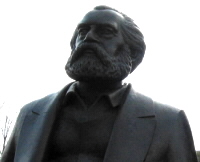
Karl
Marx
Tadeusz and I were sitting on a stony flight of steps. In front of
us there was a piazza with some plants and flowers. We were talking
about opera.
"Last
year I saw a performance about Karl Marx," I said, "That
was an interesting piece since it differed from most other performances
in this genre."
"In what way?" Tadeusz asked.
"Instead of theatricality they had striven for realism. The stage
looked like a 19th century factory. The costumes were grey and dirty."
"There's nothing new in that."
"Probably not. But they had erected big TV screens, which showed
old archive films about factory workers. Instead of opera arias the
music consisted of authentic songs the workers had sung while working
in the industrial mills."
"That's interesting."
"The songs had been woven together as a coherent whole around
Karl Marx's life and philosophy. The impression was like stepping
100 years back in time."
"That's exciting if the effect was created by means of technology
and music. That would mean that the realism was produced artificially."
"Exactly. An interesting contrast was created between the misery
of the workers and Karl Marx's own life. They led us to understand
that even as Marx opposed the ever worsening conditions of the workers
he himself enjoyed the luxuries based on the exploitation of the proletariat.
This included fine cigars and expensive liquers. He liked to visit
big cities where he could spend some time in grand settings, and he
admired expensive clothes and valuable goods, even if all this could
hardly have guessed by reading his works alone."
"Was that the historical truth?"
"I don't know. In any case I can recommend the opera to you.
It's worth checking out if it ever comes to Berlin."